


Updated: 3 hours ago
Interview with Flaminia Veronesi –“Aquatic visions, intimate ecologies”

In an era in which reality appears to fragment into pixels, Flaminia Veronesi’s work reasserts the primordial force of imagination. Born in Milan yet guided by a sensibility that transcends geography, the artist constructs fluid worlds in which the human body merges with marine creatures, plants, algae, and constellations. Her figures do not belong to a defined temporality, but rather to a dreamlike biology, in which painting becomes a language of connection among species, emotions, and mythologies.
Her practice unfolds between gesture and vision, between archaic intuition and contemporary reflection on themes such as ecology, metamorphosis, and the spirituality of living beings. At a historical moment in which artificial intelligence promises to redefine aesthetics itself, Veronesi continues to affirm manual practice as a form of knowledge. Her works do not describe the world; they breathe it.
In this conversation, Flaminia Veronesi reflects on her relationship with nature, on the role of imagination, and on the inevitable—and unsettling—encounter between art and technology.

V.S. The figures that populate your canvases appear to belong to a world suspended between biology and myth. Do you believe that painting can still invent new myths, or is it merely reawakening those of the past?
V.V. Reinterpreting the fantastical imaginary through a contemporary lens constituted the first major challenge of my research. Fantasy is often erroneously understood as an escape from reality and is therefore dismissed as frivolous. To engage in Fantasy, through the creative act it entails, is instead an assumption of responsibility—and thus an expression of freedom—toward the world we inhabit; it is anything but a means of escape.
Fantastical archetypes arise from a “playing with Fantasy,” that is, from combining elements that are already known in order to generate new forms that did not previously exist. This act of combination is nothing other than the generation of symbols, from the Greek symbállō (“to put together”), composed of syn (“together”) and bállō (“to throw”).
Historically, the mermaid (woman and fish), the centaur (man and horse), and the minotaur (man and bull) functioned as symbols born from this use of fantasy. Through the poiesis that results from combining elements into something new, symbols extend into the transcendent. This transgression enables a far closer engagement with the mystery and conflicts of human nature than purely logical or rational approaches, making symbols a fundamental tool for relating to the unknown.
If fantasy is this capacity to create through combination, play is the activity that allows such creation to be shared.
The phenomenologist Eugen Fink identifies an inner, parallel reality—one in which everything is possible—that comes into being through play. Fink refers to this parallel world as the “oasis of joy.” Play allows what we create within our inner oasis to manifest in shared reality. Thus, through play, one draws, performs, writes, and narrates—realizing, in the literal sense of bringing from imagination into the dimension of the real, what has been created through fantasy in the inner world.
In the West, we have arrived at Capitalist Realism. We have forgotten how not to know, under the illusion that everything can potentially be known and that the unknown can be dominated within a system that classifies and orders all things according to monetary value. This is a crude illusion, one that contains within itself the full banality of evil. As a result, we have lost a sense of the sacred and of the intrinsic value of things. Universities, hospitals, relationships, and leisure time are absorbed into an efficient organizational system whose ultimate outcome is the accumulation of wealth for a few.
The recovery of a symbolic language is therefore necessary in order to reestablish a dialogue with the transcendent and with the intrinsic meaning of things.
The wonder that arises from the metamorphosis of the symbol generates amazement: a force of love toward alterity that embraces difference as a resource rather than a threat, that frees us from domination, and that understands love as a transformative force—one that allows both the self and the other to exist in a state of continuous metamorphosis.
For me, art is a poetic science, understood in accordance with Giambattista Vico’s theory, which interrogates the world through wonder. It is a form of play that realizes fantasies—acts of freedom and responsibility toward the world.
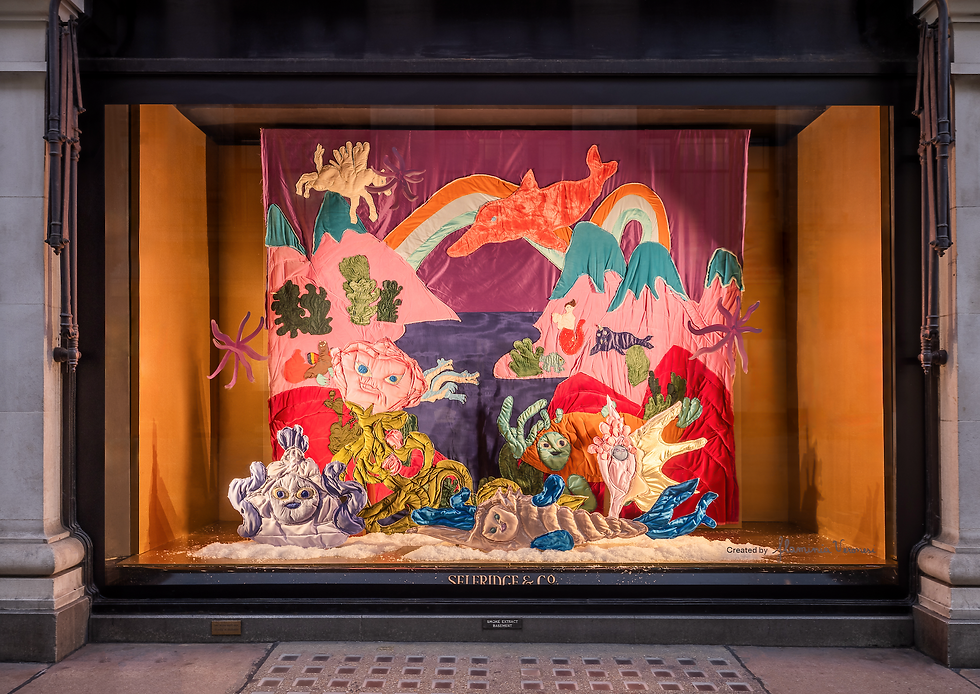
Pink whales, boats and fish with legs, red mermaids with both tail and legs, walking roses, Pagurina, Blube, cyclopes, dragons, and chimeras constitute the constellation of my archetypes—some retrieved from the past because they remain relevant, others emerging through playful engagement with the imagination.

V.S. Many artists of your generation mobilize the body as a political site. You, by contrast, seem to approach it as a cosmic space. What does it mean for you to paint the body today?
V.V. For me, it means to emancipate the body from regimes of domination through the artistic gaze—one capable of transcending historical and cultural conditioning. An art that contemplates the mysteries of creation through the study of light, anatomy, and the creative process restores the human body, and the female body in particular, to the immanent order of the world.
In the act of painting a stone, a hand, or a piece of fabric, the artist applies the same degree of attention, without hierarchy. The resulting works articulate the interdependence of elements that constitute reality. In this sense, they recall children’s drawings, in which the sky, the mother, the house, the flower, the bee, and the sun coexist on a single plane—represented not as isolated entities, but as parts of an integrated and relational whole.

V.S. In your paintings, color seems to perform an almost narrative function. How do you construct the grammar of a palette? Is it a rational decision or a sensory response to the world?
V.V. It is, first and foremost, a sensory response to the world—one that only over time becomes susceptible to rational articulation. Pink has always been a predominant color in my work, and it continues, year after year, to reveal its meanings to me.
Today, I experience pink as the color of imagination, of dawn and dusk: a threshold between one world and another. It is a chromatic space in which it becomes possible to accept and inhabit the inseparability of beginning and end, of joy and pain. In this sense, life itself appears as an ongoing dawn emerging from night, and as a cyclical process in which, after every sunset, a new world inevitably begins.

V.S.Your visual universes seem to operate according to a non-anthropocentric logic, in which animals, plants, and bodies coexist without hierarchy. Do you believe that art can propose an alternative model of ecological coexistence?
V.V. Absolutely. It is my intention to pierce the collective imaginary through images that begin to make us envision a different future—one in which, having moved beyond domination, we inhabit the world with an awareness of and responsibility for the network of interdependence that binds us.

V.S. Your practice brings together painting, drawing, and installation. In a time when everything has become image, why do you continue to believe in the slowness of the hand?
V.V. Maria Montessori intuited that linking movement to cognitive learning would enhance its effectiveness. Today, scientific research has demonstrated that thinking with the hands—or with the body more broadly—generates a greater density of neural connections. Human action unfolds within a balance that expresses the highest synthesis of sensation and reason. To inhabit our animal dimension as embodied beings is the first step toward accepting the unknown and recognizing our place within the order of the world.

V.S. Spirituality permeates your work, yet never in an explicit way. Does it interest you as a theme, or as a condition for creation?
V.V. Certainly. The transcendent, joy, enchantment, and love understood as gift are, in fact, shared concerns of many philosophies and religions, including Christianity. For me, feminism is a practice of love, understood as a transformative force that liberates the human.

V.S. If you could transport one of your works to a non-human site—a seabed, a planet, a dream—where would you choose to exhibit it, and why?
V.V. My art already lives within my oasis of joy. I have access to an entirely pink world in which my archetypes exist and generate wonder, offering me visions. I nurture and care for this world by playing with imagination and by inhabiting pain.
That said, I would like to place my work in the jungle, in forests, in caves, on the ocean floor, on the moon, in outer space, on the summit of a mountain, underground, within a tree—always in dialogue with wonder.
V.S. An increasing number of designers and artists are engaging with artificial intelligence. In your view, can AI function as a new creative medium, or does it risk emptying fashion (and art) of its human imperfection, which so often generates truth?
V.V. The crucial issue in relation to artificial intelligence and technology has always been the ethical one: to use them responsibly and to resist reducing the human to a servant of technology.
When individuals are genuinely free—that is, responsible for their own existence and no longer operating within dynamics of domination over others—technology can be employed as a means of gaining deeper access to the sacred and to the essence of life.
Painting itself, for instance, might be understood as a form of artificial intelligence: a system that allows human beings to recreate an apple through techniques of optical illusion. Over time, art has continually recreated the world through evolving systems of representation and knowledge.


Comments