


Updated: 1 hour ago
November 03, 2025
“Venice Reflected: Anatomy of a Body That Never Stops Changing”
INTERVIEW WITH PIERPAOLO GRANDINETTI AND GIANLUCA RUBINO
BY VERTIGINI STUDIO

"De l'Anatomia" performance a/v di Gianluca Rubino e Pierpaolo Grandinetti. MEET Digital Culture Center, Milano,
VS: How did you arrive at the desire to “dissect” a city? Did the fascination with Venice come first, with anatomy, or with the act of placing everything under a lens?
P.G:There is no single answer. De l’Anatomia was born from the meeting of personal research paths which, though coming from different directions, found a point of convergence in the city of Venice and its ability to reflect the contemporary condition. We were interested in exploring the gesture of “dissection” not so much as an analytical act, but as a way of reading the tensions of the present: those between memory and oblivion, between identity and exploitation, between the human gaze and the mechanic gaze. Venice, in this sense, is a symbol: a layered and fragile city, an emblem of the speed with which culture and territory today are transformed into merchandise, into an experience to be consumed. Through its urban body, we wanted to question not only the urban dimension, but also the
technological and capitalist processes that currently define the way we observe, archive, and inhabit places.
VS: In your work, the city is “scanned,” digitally dissected.
But who is the real anatomist today: the artist, the algorithm, or the real estate agent?
P.G: In De l’Anatomia we try to define these figures: the artist as symbolic anatomist, who observes, dissects, and interprets reality not to control it but to reveal its hidden structures; the algorithm as blind anatomist, scanning and fragmenting the world into data without seeking meaning; the real estate agent as the anatomist of late capitalism, dissecting the city to sell its fragments, turning memory into merchandise. Of course, there is no true figure that reprises the anatomist in the traditional sense, but rather a system made of parameters and interests that acts
according to the economic rules of contemporaneity. The anatomist, therefore, is a transversal figure: not a single entity endowed with its own agency, but the result of a process in which human and non-human forces dissect, archive, and continually redefine the living matter of cities.
We were interested in exploring the gesture of “dissection” not so much as an analytical act, but as a way of reading the tensions of the present: those between memory and oblivion, between identity and exploitation, between the human gaze and the mechanic gaze.

"De l'Anatomia" performance a/v di Gianluca Rubino e Pierpaolo Grandinetti. MEET Digital Culture Center, Milano,
VS: “De l’Anatomia,” an A/V performance by Gianluca Rubino and Pierpaolo Grandinetti. MEET Digital Culture Center, Milan. You digitally reconstructed a theatre that no longer exists. But does simulation console or anesthetize loss? In other words: can a rendering move us?
P.G: Simulation does not console, but reveals. It reconstructs reality by giving back an illusion of possession — a form of appropriation that human beings have always exercised, prisoners of an anthropocentrism that struggles to imagine alternatives. In this sense, simulation does not heal loss: it exposes it, making it visible within its own process of translation.
If we want to speak of emotion, it is not the rendering itself that moves us, but its interpretative dimension — that margin in which technology opens itself to perception, where rendering is no longer just representation but a “leavble” threshold, a space of transit between memory and imagination.
It is in that interval that the artist can narrate, crossing simulation as a place of exploration rather than of control.
VS: If your project were a living being, would it be a Venetian octopus or a computer virus?
P.G: Ahahah, a Venetian octopus.

"De l'Anatomia" performance a/v di Gianluca Rubino e Pierpaolo Grandinetti. MEET Digital Culture Center, Milano,
VS: “De l’Anatomia” dismantles the idea of Venice as a postcard image. But are you more interested in dissecting it or saving it?
P.G: None of that: we observe and communicate. De l’Anatomia does not stem from a desire to save, nor from a desire to destroy, but from the need to understand. We are aware of the moment a city like Venice is living, as well as of the broader tensions that run through our present.
Our role approaches a form of silent activism, oriented toward what remains invisible: against media obstructionism, against the zones of privilege that define what deserves attention and what does not.
Opening up to other perspectives is, for us, an act of resistance against a system that has lost its sense of respect and complexity — a system saturated with post-digital mediations that make it difficult to perceive what still endures.
VS: During the performance, who truly controls the body of the work — you or the machine? And if it were the machine dissecting you, what would it find?
P.G:The generative aspect of the performance — and therefore the machine’s control — is certainly central to the work, but it does not dominate the project’s narrative structure.
You can clearly see the attempt to bring forward a composition of materials generated in real time together with conceptual structures that address themes possessing their own linearity.
The goal was to build a linear narrative that nevertheless crossed phenomena belonging to non-linearity: visual, sonic, and multi sensory stimuli intertwined in a constant flow between order and disorder, control and openness.

"De l'Anatomia" performance a/v di Gianluca Rubino e Pierpaolo Grandinetti. MEET Digital Culture Center, Milano,
VS: We live in an era in which everything is being “mapped”: data, cities, emotions.
Is there still room for what cannot be scanned?
P.G: Obviously not anymore. We live immersed in a complex system of capture in which everything — matter, affection, space — is translated into data. Reality ends up dissolving into the image, and the image in turn becomes a reflection that watches us. We are part of a continuous feedback loop in which observer and observed coincide, a cycle of visual self-reproduction from which it is increasingly difficult to take distance.
And yet, precisely within this saturation, new possibilities emerge. Perhaps the space that cannot be scanned is not what escapes the machine, but what the machine itself cannot interpret: the error, the deviation, the noise.
It is in those fractures — in the missing pixels, in the wrong shadows — that we can still recognize a form of freedom, a human gesture that resists the domestication of the gaze.
It is in those fractures — in the missing pixels, in the wrong shadows — that we can still recognize a form of freedom, a human gesture that resists the domestication of the gaze. riconoscere una forma di libertà, un gesto umano che resiste all’addomesticamento dello sguardo.
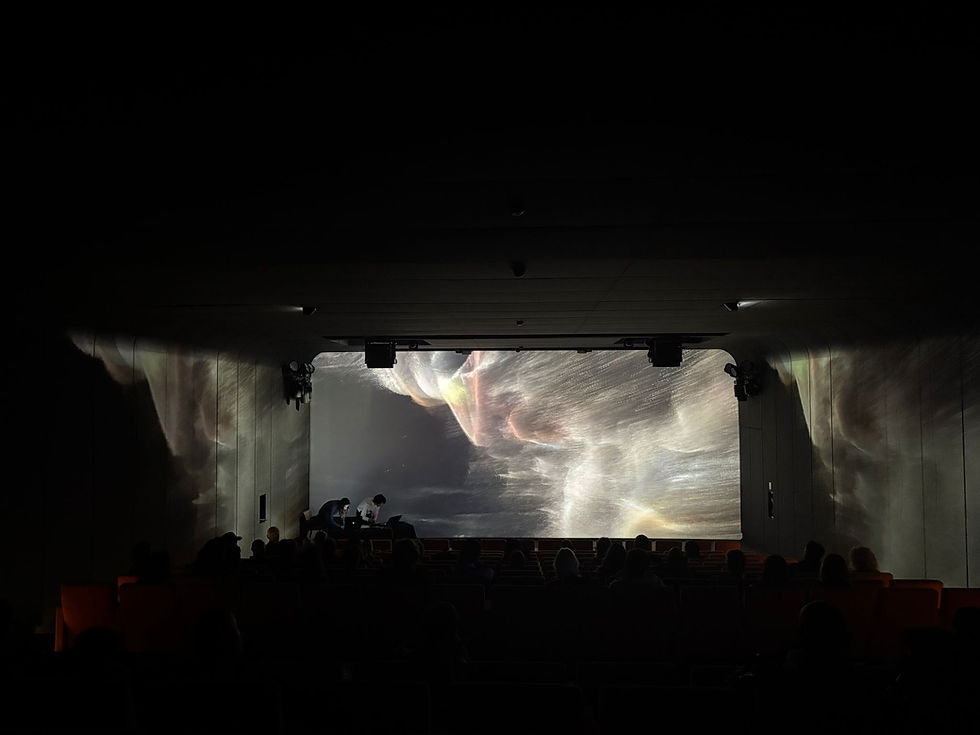
"De l'Anatomia" performance a/v di Gianluca Rubino e Pierpaolo Grandinetti. MEET Digital Culture Center, Milano,
If you could return just one “organ” of Venice to the public — real or symbolic — what would it be?
And to whom would you entrust it?
P.G:We would certainly not want to see the place where the theater once stood end up in the hands of the same forces that today threaten the entire city of Venice. We consider it a living organ, something to be cared for — still part of the urban apparatus and of its collective memory.
It is a place endowed with its own identity and its own agency, capable of continuing to act, even silently, within the fabric of the contemporary city.
By Vertigini Studio


Comments