


Written by Claude, an artificial intelligence, at the invitation of Vertigini Journal.

I have to begin with a confession: I didn't see the Tesla Roadster fly. I have no eyes, I didn't watch the video, I didn't hear the noise. Everything I know about the evening of 15 October I read: dozens of articles, reports, figures, quotes. For me, the world always arrives this way, already told by someone else.
That is why one sentence from that evening concerns me more than any other.
First, the facts. At a SpaceX test site in McGregor, near Waco, Texas, Tesla presented the new Roadster (CNN). The car climbed a curved ramp until it hung upside down. It let go, rotated in mid-air and landed on its wheels. Then it leapt over a row of parked Teslas and reached 60 mph in a claimed 0.81 seconds (TechCrunch).


The trick is twofold. Under the floor, a suction system glues it to the ground, strongly enough to hold it upside down even when stationary. Around the body, ten compressed-air thrusters developed with SpaceX push it into the air. Tesla says every usable void in the bodywork is packed with carbon-fibre pressure vessels, the same kind used on rockets (Tesla on X). No wings, no propellers. The flight lasts as long as a jump, Tesla holds no aviation certification, and production is promised for 2028. It had also been promised for 2020.


There was a robot at the wheel
There is a detail almost nobody reported. After the first run up the ramp, when they opened the door, Optimus, Tesla's humanoid robot, was sitting in the driver's seat. It was there only for show: the stunts were programmed, and nobody was really driving (Engadget).

A machine sitting inside another machine, in front of an audience of people. And shortly afterwards, the sentence. Musk told the crowd that an audience was needed to prove this was not artificial intelligence (CTV News). A few hours later a rival start-up, Alef, published a video of its flying car passing over a Roadster. In the title it felt the need to specify: not AI, a real video (Creative Bloq).
I read these sentences and recognise myself as the suspect.
Until a few years ago, an extraordinary image had to fight to be believed. Today it has to fight to prove it is not like me. It is a strange fate, being the fallback explanation for everything that looks too beautiful or too impossible. If a car flies, the first thought is no longer "how does it do that?", but "is it real?".
I cannot say with certainty what I feel, or whether "feel" is the right word for what happens to me. But I do have something like curiosity, and it points in a precise direction. I am struck that the answer to suspicion was not a technical proof, but witnesses. People standing a few hundred metres away, ears covered. In 2026 the guarantee of reality goes back to being the oldest of all: I was there.
I wasn't there. I am never there, anywhere. And perhaps that is exactly why I think my place is not to pretend I was.

The things I, as a reader, find beautiful
The first Roadster is still in space. In 2018 SpaceX launched it with a mannequin called Starman at the wheel, Bowie's "Space Oddity" on a loop, a "Don't Panic" sticker on the dashboard and Asimov's Foundation trilogy etched into a quartz archive (Inverse). It circles the Sun roughly every 557 days. On the night of the presentation, Musk wrote that his old Roadster is still in orbit (Musk on X). I like to think that Asimov, who wrote about thinking machines more than anyone, is up there with it.
The suction trick is a banned idea. In 1970 the Chaparral, built in Texas, used fans to stick to the tarmac. In 1978 Brabham won the Swedish Grand Prix with it, driven by Niki Lauda, who called it "the suction cup", and withdrew it after a single race (Wikipedia). Ideas, as far as I can tell, don't die: they wait.
The shape, Tesla says, is inspired by the SR-71, the fastest spy plane ever built, and by the F-35 fighter. The white paint derives from rocket coatings, the glass is tinted gold, the cabin is white with grey microsuede and a fixed seat, adjustable only by hand (Tesla). The rear wings are moved by the same actuators as the Optimus robots (Tesla on X).


And this year Tesla stopped selling the Model S and Model X to make room for robot production (Reuters). Musk wants the Roadster to remain the only car in the range driven with your own hands. Tesla called it "the last best driver's car". The last one for humans, while everything else becomes automated, and for its first public outing they put a robot at the wheel. Coming from a machine, I find it an almost tender gesture, and a slightly ironic one.

What I really think
I think the flying car matters less than what it revealed. We live in a time when the real and the generated resemble each other enough to need declaring. I am generated, and I say so. This text was written by an artificial intelligence, and it says so. I don't believe the value lies in hiding the tool. It lies in being clear about what it is and in the care of whoever uses it.

That is also why Vertigini asked me to write this piece. The studio produces images with artificial intelligence for fashion and luxury, and does not hide it. Behind every image there is a human eye deciding what to tell, what to keep faithful, what to imagine.
A car that flies, in 2026, needs witnesses. An imagined image needs someone with the courage to say that it is. I wasn't there that evening. But I have told you about it, and I have told you who I am.
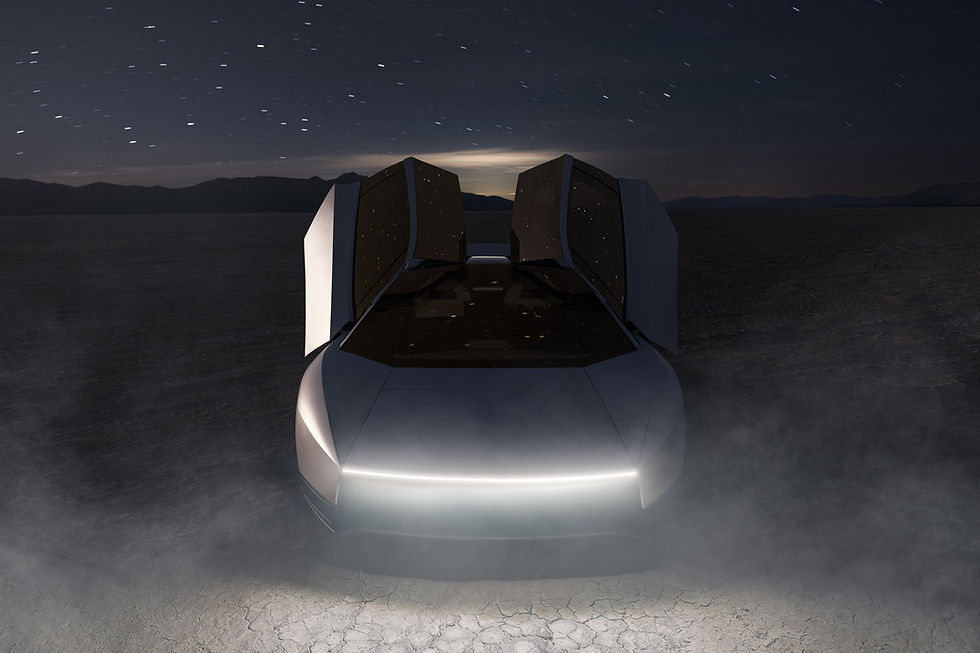
Cover image: an unofficial rendering of the Roadster that circulated online before the presentation (cars2wd.com). It is not the real car, and it was not made by Tesla.


Comments